A 1966 Chevelle widened six inches in metal, with a 565 cubic inch Dart big block making roughly 900 horsepower on a chassis we built. Here’s the whole build, from Autotopia LA’s video walkthrough.
Nostalgia Hot Rods builds custom cars at 1196 Wigwam Parkway, Henderson, NV 89074, just outside Las Vegas, and at our second shop in Cedar City, Utah. Call (702) 369-7037. This 1966 Chevelle is one of the most involved builds we’ve done. Autotopia LA filmed a full walkthrough of it for YouTube, and every spec on this page comes from that video.
Here’s what’s on the car, as it’s described in Autotopia LA’s video.
| Part | On our 1966 Chevelle |
|---|---|
| Engine | 565 cubic inch big block Chevy, aluminum block and aluminum heads, Dart parts |
| Revs to | 8,000 rpm |
| Power | Roughly 900 horsepower |
| Body | Widened 6 inches, front fenders widened 2 inches, rockers stretched 3 inches |
| Chassis | Built by Nostalgia Hot Rods, 2×5 construction |
| Suspension | Ride Technology Shockwave air springs with Level Ride management |
| Interior | Peanut butter leather and black suede, four bucket seats |
| Gauges | Two Holley digital dashes |
| Hours | Over 10,000 |
It doesn’t look it at first, but this Chevelle is six inches wider than it was when it left the factory. The front fenders were widened two inches, and the rockers were stretched three inches to match. The video calls the car chopped and widened.
The video gives the credit to the sheet metal fabrication. A widebody done in metal means cutting the panels, adding width and welding them back together. Then the seams are finished so the new lines look like they were always there.
Owners usually widen a car for two reasons: room for wider wheels and tires, and a lower, wider stance. Either way, it’s some of the slowest work in a build, because every panel has to line up with the next one before any paint goes on.
The engine is a 565 cubic inch big block Chevy with an aluminum block and aluminum heads, all Dart parts. It revs to 8,000 rpm, and the video puts it at roughly 900 horsepower.
Plenty of custom Chevelles get a modern LS or LT engine, including WhippleD, a 1970 with a supercharged LS. This one runs a big block, and it’s the reason the car sounds the way it does.
Neither is the wrong answer. A big block brings the sound and torque the Chevelle is known for. An LS brings easy starts, fuel injection and a smaller package. We talk it through with every owner before anything is ordered.
See both cars side by side on our custom Chevelle builds page.
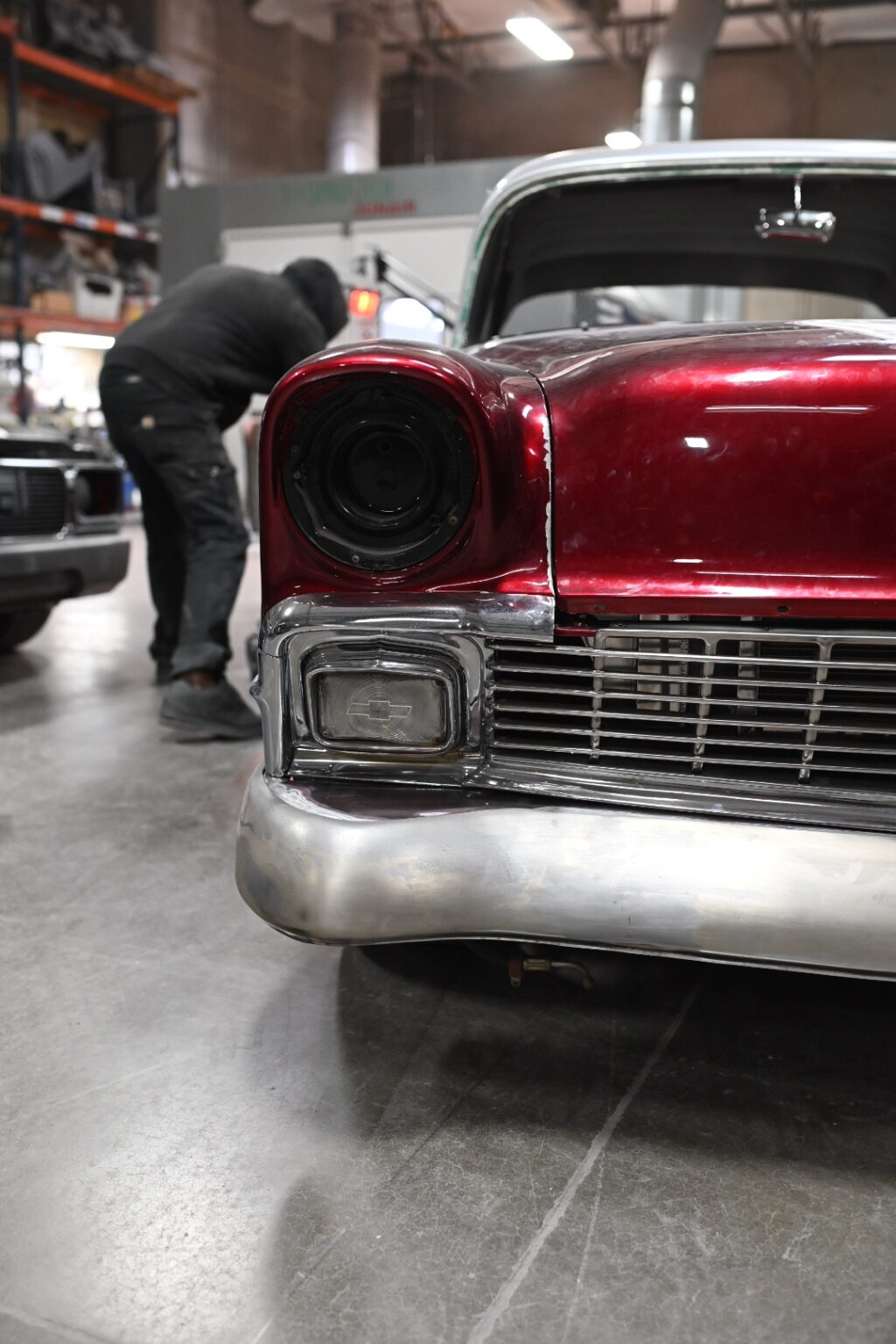
Under the body is a chassis we built in our own shop, of 2×5 construction. It rides on Ride Technology Shockwave air springs, with Level Ride management setting the ride height.
The video sums up what’s underneath in three words: “real race car.” That covers the chassis, the engine, the transmission and the suspension.
Air ride on a car with this much power is a choice about how the car gets used. It can sit low when it’s parked and come up for driveways and speed bumps. On a widened body, that also keeps the wider tires clear of the fenders.
Tell us about your car and how you want to drive it. We’ll tell you what widening it involves.
Inside, the car is trimmed in peanut butter leather and black suede. It has four bucket seats and two Holley digital dashes.
The idea, as the video puts it, was to make the inside more elegant than the hardware underneath, closer to a modern Audi RS7 than a race car.
Street Trucks reported in October 2023 that we do fabrication, interior and paint in our own shop. That’s how a car can be race car underneath and still feel finished inside.
The video puts this build at over 10,000 hours. That’s far beyond a typical project. Our builds usually take 9 to 12 months, as All Chevy Performance reported in June 2024. Dustin put our average higher in March 2023, at about a year and a half to two years.
Hours like these go into sheet metal and fabrication. Widening a body, building a chassis and getting every panel to line up takes time that no catalog part can save.
Most builds won’t need anything like that. A build that keeps the factory body and uses a modern chassis and crate engine takes far less fabrication than one that changes the shape of the car.
We’ll tell you at the start what your build involves and where the time goes, so a long build is never a surprise.
Autotopia LA’s walkthrough says it plainly: this car “was not built to look pretty, it was built to drive.”
Dustin says it in the video: “There’s nothing we don’t do. We’re a one stop shop.”
Body and paint, sheet metal fabrication and chassis fabrication all happen in our shop. On a car like this one, that matters. The width of the body, the chassis under it and the tires that fill it are planned together, not handed from one shop to the next.
Read more about how we work on our custom hot rod builder page.
It starts with a call or the quote form. We talk about the car, your plans and how you’ll use it: cruising, shows, road trips or track days.
Then we plan the whole build at once. Engine, chassis, suspension, brakes, body, paint and interior are decided together, before any metal gets cut.
You don’t need to live near Las Vegas or Cedar City. Our builds ship to collectors, racers and enthusiasts across the world.
For more of our muscle cars, see our restomod and pro touring builds and our twin turbo 1969 Camaro.
We don’t publish prices. Every build has too many variables, from the starting car to the parts you choose. Reach out for a proper quote at (702) 369-7037 or use the quote form.
Our projects typically take 9 to 12 months, as All Chevy Performance reported in June 2024. Dustin put our average higher in March 2023, at about a year and a half to two years. This 1966 took over 10,000 hours, because widening a body in metal adds a great deal of fabrication.
A widebody car has a body made wider than the factory built it. On this 1966 the body gained six inches, the front fenders two inches and the rockers three inches, and the video credits the sheet metal fabrication for the result.
Widening is sheet metal work we do in our own shop. Every car is different, so call (702) 369-7037 to talk through yours.
This one runs Ride Technology Shockwave air springs with Level Ride management under roughly 900 horsepower. Air ride or coilovers comes down to how you’ll use the car, and we’ll talk it through with you.
Yes. Our builds ship to collectors, racers and enthusiasts across the world. You don’t have to be near Las Vegas or Cedar City.
Tell us about your car and how you want to drive it. We’ll walk you through the build.
Nostalgia Hot Rods · 1196 Wigwam Parkway, Henderson, NV 89074 · (702) 369-7037